


Counting windows explained
Every rule counts days over some window of time — and the window shape is where rules differ most. Reset dates, rolling spans, weighted years: get the window wrong and the count is meaningless. Bounded implements each shape exactly, and every built-in counter ships with the right one.
Rolling window
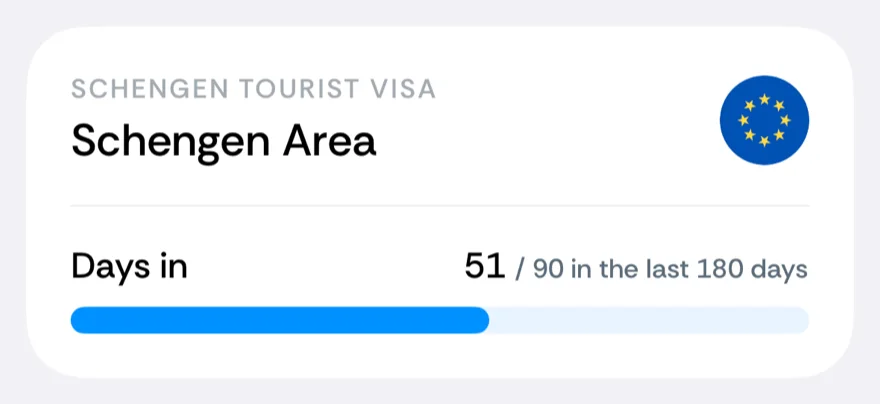
X days in the last Y days, measured back from today — the window moves forward every midnight, which is why these rules are so easy to miscalculate by hand. Days used near the start of the window “free up” as it slides past them. The classic example is Schengen’s 90 in 180. When a rule is written in months or years — “any 12 months”, “the last 5 years” — the window starts the day after the same date that many months or years back — or, when that date does not exist, the day after the last day of that month. So 12 months ending 28 February 2025 start on 29 February 2024, the way the Home Office counts it; a span containing 29 February holds the extra day exactly as the law does. The card shows the days the window actually holds, such as “in the last 1,826 days”.
Calendar year
X days per calendar year, resetting on January 1 — the shape of most 183-day tax-residency rules. On New Year’s Day the count starts from zero.
Tax year
Like a calendar year but with a country-specific start date — the UK tax year begins April 6, Australia’s July 1. The counter card shows the span, e.g. 12 / 90 in tax year 2026/27.
Per visit
A cap on each continuous stay, resetting when you leave — visa-free limits like US ESTA (90 days per visit; a trip to Canada, Mexico or a nearby island doesn’t restart it) or the UK Visitor rule. Some rules stack a rolling or yearly cap on top: Schengen combines a 90-day visit cap with the 90/180 rolling budget, and India’s tourist visa adds a 180-day calendar-year aggregate. Both limits count toward the verdict. Schengen’s card shows the rolling budget (X / 90 in the last 180 days); India’s shows the current visit and the yearly total (X / 90 days this visit · Y / 180 total). One counter bridges short trips out: Switzerland Tax Residency does not restart the stay after a trip abroad of up to 30 days — the stay carries on, but the days away are not added. Swiss law speaks only of temporary interruptions and names no number of days; 30 is Bounded’s own cautious line, since a restart would understate the stay.
A visit is an unbroken run of days in the region. Leaving ends it (apart from those short Swiss trips) — and so does a day Bounded has no data for: an unknown day is never bridged, so a stay with a gap in the middle counts as two shorter visits. If you were there the whole time, fill the gap and the visit becomes one again.
Dual rolling windows
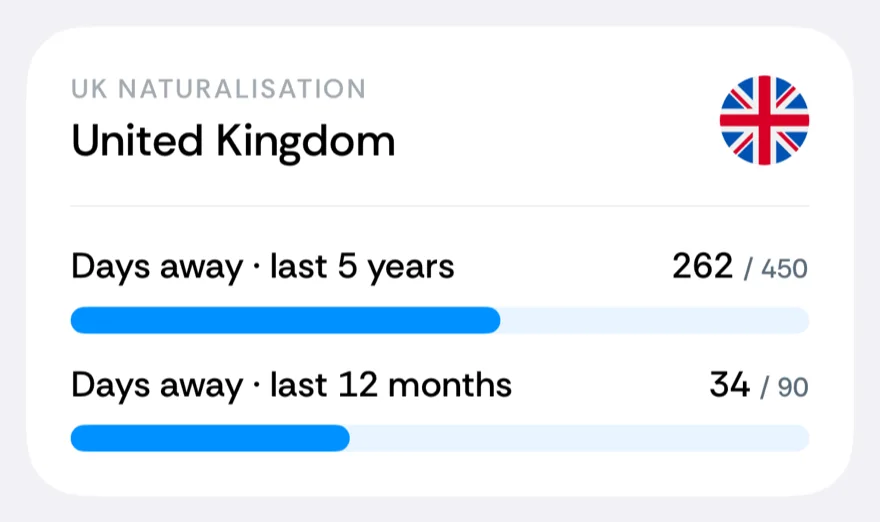
Two rolling caps evaluated together, exceeded if either trips — the shape of UK Naturalisation’s absence rule (at most 450 days away in 5 years and at most 90 days away in the final 12 months). The card shows two labeled bars:
Weighted years
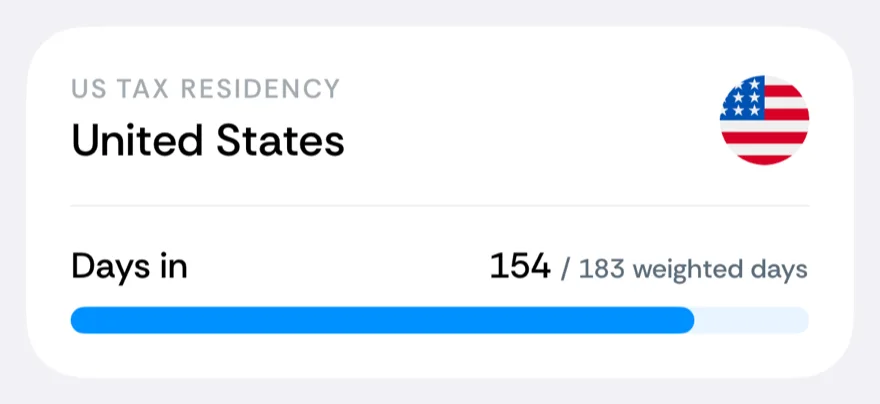
A multi-year formula where past years count fractionally — the US Substantial Presence Test: all of this year’s days, plus a third of last year’s, plus a sixth of the year before, against 183.
Consecutive absence
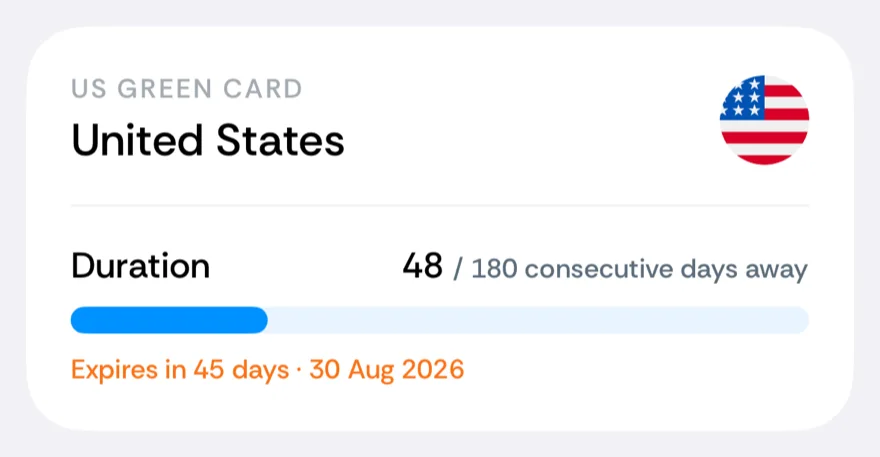
The current absence, or the earliest completed absence that went over the limit — the shape of residency-maintenance rules like the US Green Card’s 180-day absence concern. One qualifying return home ends it, and the next trip starts a new one. On residence-permit and status presets, an absence starts the day after your last recorded day in the tracked area (or on your first recorded day away, if nothing there is recorded before it). Days with no record count as away until your next recorded day, but a trip you log ends the absence on its end date if nothing is recorded after it. An absence that passed the limit stays on the card, with its dates, because returning does not erase it. A new count-from date (a new permit or qualifying period) clears only absences that ended before it; an absence still running on that date counts from its real start. See absence counters.
Fixed window
Days within two fixed dates — a single-entry visa’s validity period, where both the day budget and the window come stamped by a consulate.
Overstayed or Reached
Whatever the window shape, a rule points one of two ways. A stay-under cap (a visa limit, an absence ceiling, a tax threshold you want to avoid) turns the bar red and badges the card Overstayed once the count exceeds it. A reach-at-least goal (qualifying for tax residency, meeting a naturalization presence requirement) turns green and shows Reached once the count meets it — it is never labeled Overstayed, because going past a floor is the point.
Planned trips in the window
Trips you have planned for the future do not change today’s count — a planned day is not a lived day. Counters whose window reaches into the future do fold them into a forecast, so a Schengen card can tell you where you will stand once next month’s trip is over. As each planned day arrives, GPS, photo, or manual data replaces it.
Related articles
Can’t find what you’re looking for? We answer every message.
Contact support