


How border-crossing days are counted
Fly from New York to Paris and the day you land belongs to two countries at once. How that day is counted is exactly where hand-kept spreadsheets go wrong — most visa and tax rules count arrival and departure days in full, in both places. Bounded models this directly.
Transition days
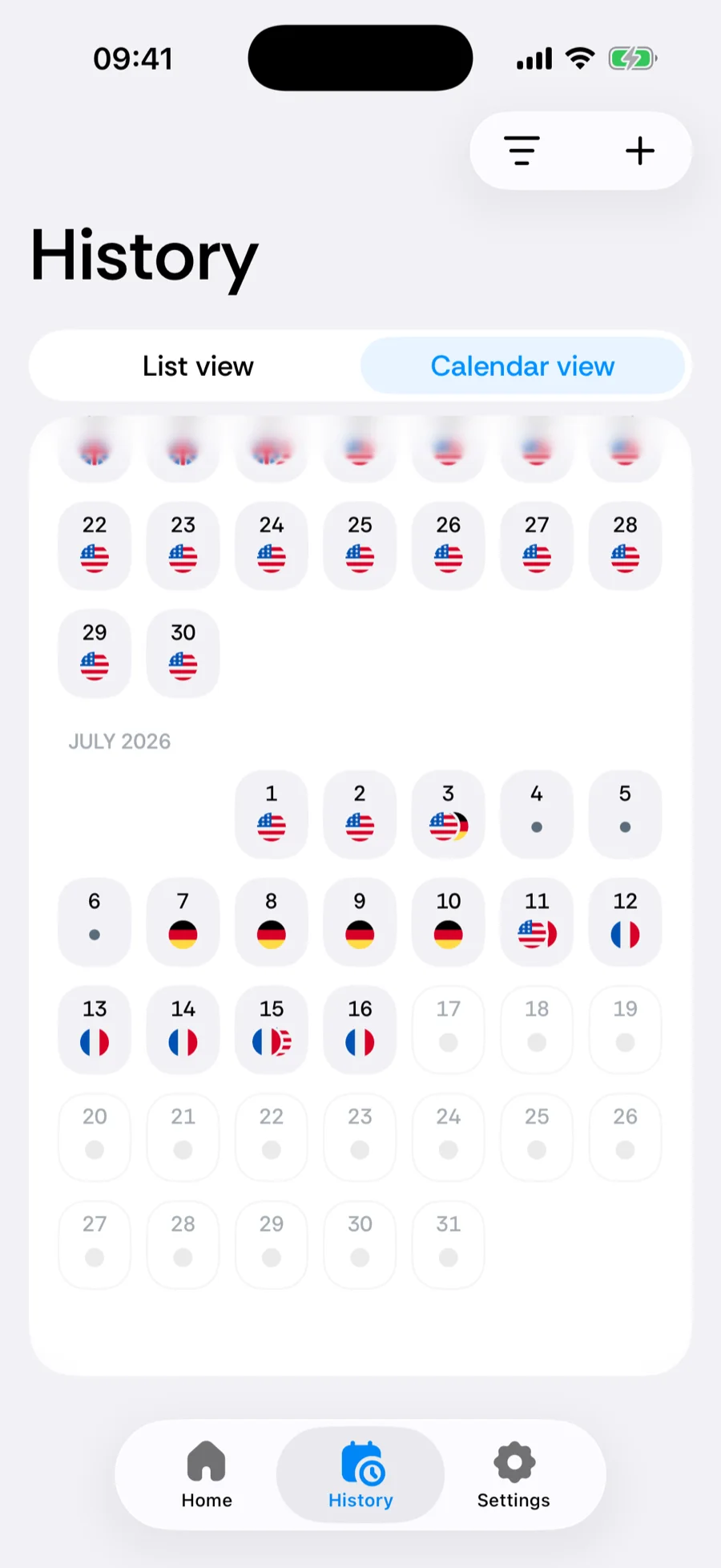
A day where Bounded sees you in more than one country becomes a transition day. It counts as a full day in each country involved — so the day you enter the Schengen Area already consumes a Schengen day, and the day you leave does too. That matches how the Schengen Borders Code, the UK, the US, and most other jurisdictions count “any part of a day.”
In the History calendar, transition days show a split flag; in List view, border-crossing stays of under a day show as < 24 hours.
What does not count
- Flyovers — the photo scan drops photos taken above 5,000 m, so a picture out the plane window over a country you never entered does not create a visit.
- Double counting within a day — a day is counted at most once per country, no matter how many photos or location updates land there. Aggregate counters like “days abroad” count each calendar day once in total.
Rules that count midnights, not days
A few jurisdictions — most prominently the UK’s Statutory Residence Test — count where you are at midnight rather than any part of a day. Under that convention, arriving Thursday and leaving Friday is one day (one midnight). Bounded’s UK Tax Residency and Portugal NHR counters count this way: a day counts only in the country you end it in. Every other counter counts any part of a day and records two, so if you track a midnight-counting rule with one of them, your number is a conservative ceiling — the statutory count is at or below it. When you need the exact midnight figure for a filing, your day-by-day export shows every border crossing, making the midnight arithmetic straightforward to derive.
Airport transit
Bounded records where your phone was, so a layover in Istanbul counts as a Turkey day. For most rules that is the right call — many countries count airside transit differently on paper, but proving it later is on you, and the conservative count keeps you on the safe side. If a specific rule lets you discount a transit day, you can edit that day manually.
Related articles
Can’t find what you’re looking for? We answer every message.
Contact support